



If you’ve recently shopped for a laptop, desktop PC, or smartphone, you’ve probably come across terms like CPU, GPU, and NPU. While most people are familiar with CPUs and graphics cards, NPUs have quickly entered the spotlight thanks to the rapid growth of artificial intelligence.
Today’s devices no longer rely on a single processor. Instead, manufacturers combine multiple specialized processors that work together to deliver faster performance, better battery life, and advanced AI capabilities. Whether you’re editing videos, playing games, generating AI images, or simply browsing the web, different processors handle different parts of the workload.
Understanding how these processors work can help you choose the right device and appreciate why modern hardware has evolved beyond the traditional CPU-only design.
What Is a CPU?
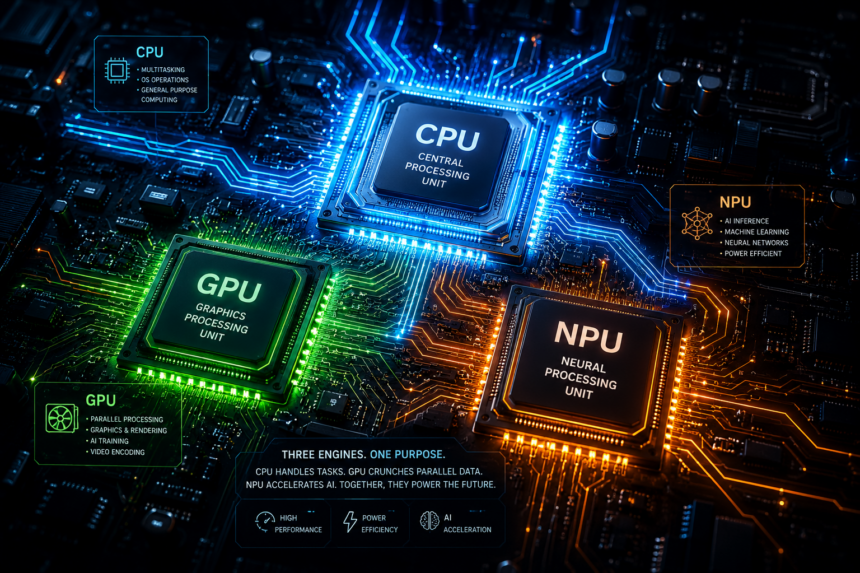
The Central Processing Unit (CPU) is often called the brain of a computer. It manages the operating system, runs applications, processes instructions, and coordinates communication between all hardware components.
Every task you perform—opening software, browsing the web, typing documents, or launching games—begins with the CPU.
Modern processors from Intel, AMD, Apple, and Qualcomm feature multiple cores capable of handling several tasks simultaneously, making today’s computers significantly faster than previous generations.
What Is a GPU?
The Graphics Processing Unit (GPU) was originally designed to render images, videos, and 3D graphics. Unlike a CPU, which excels at handling sequential tasks, a GPU contains thousands of smaller cores capable of processing many calculations simultaneously.
More Read



This parallel architecture makes GPUs ideal not only for gaming but also for video editing, scientific simulations, cryptocurrency, and artificial intelligence.
Companies such as NVIDIA, AMD, and Intel continue to expand GPU capabilities, making them one of the most important components in modern high-performance computing.
What Is an NPU?
The Neural Processing Unit (NPU) is a dedicated processor built specifically for artificial intelligence workloads.
Instead of rendering graphics or running general-purpose software, an NPU accelerates tasks such as speech recognition, image enhancement, language translation, object detection, and AI-powered assistants.
Running these workloads locally improves performance while reducing power consumption and protecting user privacy because sensitive data doesn’t always need to be sent to the cloud.
As AI becomes integrated into everyday software, NPUs are becoming standard in many laptops and smartphones.
CPU vs GPU vs NPU: What’s the Difference?
Each processor has a different role within a modern device.
| Processor | Primary Role | Best At |
|---|---|---|
| CPU | General computing | Operating system, applications, multitasking |
| GPU | Parallel processing | Gaming, graphics, video editing, AI training |
| NPU | Artificial intelligence | AI assistants, image processing, voice recognition, on-device AI |
Rather than replacing one another, these processors complement each other to deliver the best overall performance.
GizmoAlert Insight: Think of a modern computer as a well-organized team. The CPU acts as the manager, the GPU handles large-scale visual and mathematical workloads, while the NPU specializes in AI tasks that require speed and energy efficiency.
Why Are NPUs Becoming So Important?
Artificial intelligence is no longer limited to cloud services. Many AI features now run directly on laptops and smartphones, enabling faster responses and better privacy.
Microsoft’s Copilot+ PCs, Apple’s latest Macs and iPhones, Qualcomm Snapdragon X processors, Intel Core Ultra chips, and AMD Ryzen AI processors all include dedicated NPUs designed to accelerate local AI tasks.
These processors make features such as live captions, image generation, background blur, voice transcription, and intelligent search possible without relying entirely on an internet connection.
Which Processor Handles Everyday Tasks?
Most everyday activities rely on a combination of processors.
| Activity | Primary Processor |
|---|---|
| Web browsing | CPU |
| Office work | CPU |
| Gaming | CPU + GPU |
| Video editing | GPU + CPU |
| AI image generation | GPU + NPU |
| Voice assistants | NPU |
| Live translation | NPU |
| Photo enhancement | GPU + NPU |
This collaboration allows modern devices to balance performance, responsiveness, and battery efficiency.
The Future of Computing
The rise of artificial intelligence is changing processor design. Manufacturers are no longer competing solely on CPU speed or GPU performance. Instead, the integration of powerful NPUs is becoming a major selling point for laptops, desktops, and smartphones.
Future processors are expected to deliver faster AI inference, lower energy consumption, and more advanced on-device capabilities, enabling users to run increasingly sophisticated AI models without depending entirely on cloud services.
Final Thoughts
The days when a computer relied solely on its CPU are over. Modern devices use CPUs, GPUs, and NPUs together, with each processor handling the tasks it performs best.
As AI continues to reshape personal computing, understanding these specialized processors will become increasingly important when choosing a new laptop, desktop, or smartphone. Whether you’re a gamer, content creator, developer, or everyday user, knowing how these components work together will help you make smarter technology decisions.