



Artificial Intelligence often dominates technology headlines, but behind many of today’s smartest systems lies another powerful technology: Machine Learning. Whether you’re receiving personalized recommendations on Netflix, unlocking your phone with facial recognition, or asking ChatGPT a question, there’s a good chance machine learning is working behind the scenes.
Unlike traditional software that follows fixed rules written by programmers, machine learning allows computers to analyze data, recognize patterns, and improve their performance over time. Instead of telling a computer exactly what to do in every situation, developers provide data and let the system learn from it.
As AI adoption continues to grow across healthcare, finance, retail, transportation, and cybersecurity, understanding machine learning has become increasingly valuable for students, professionals, and technology enthusiasts alike.
What Is Machine Learning?
Machine Learning (ML) is a branch of Artificial Intelligence that enables computers to learn from data and make predictions or decisions without requiring explicit programming for every possible outcome.
Rather than following rigid instructions, machine learning models identify relationships within large datasets. As they process more information, they gradually improve their accuracy and become better at performing specific tasks.
This ability to adapt makes machine learning especially useful for problems that involve massive amounts of data or constantly changing conditions.
How Machine Learning Works
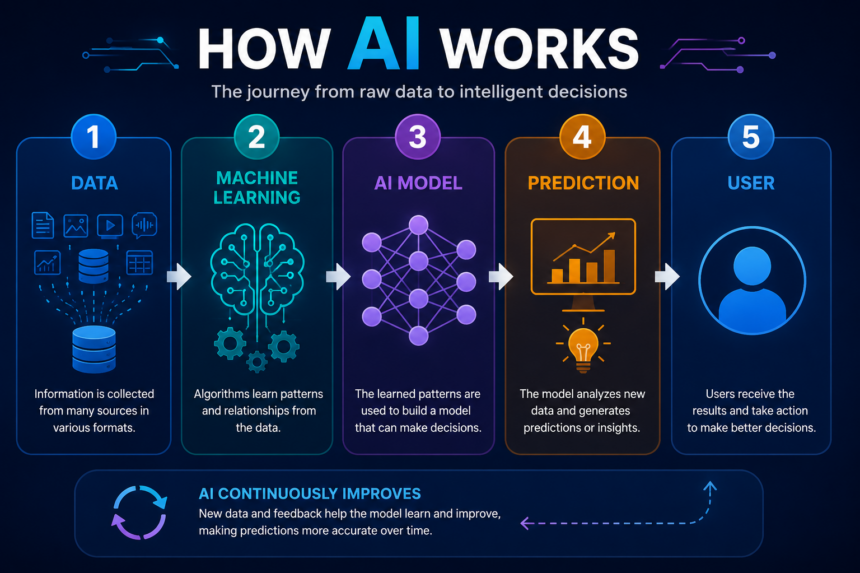
The learning process begins with data. Developers collect examples related to a specific problem, such as images, customer purchases, medical records, or financial transactions. That information is then cleaned, organized, and used to train a machine learning model.
More Read





During training, the model searches for patterns that connect inputs with expected outcomes. Once training is complete, the model is tested using new data to measure how accurately it can make predictions. If performance is satisfactory, the model can then be deployed into real-world applications where it continues making predictions based on what it has learned.
Unlike traditional software, the quality of a machine learning system depends largely on the quality and diversity of the data it receives.
The Three Main Types of Machine Learning
Machine learning techniques generally fall into three major categories.
| Learning Type | How It Works | Common Examples |
|---|---|---|
| Supervised Learning | Learns from labeled training data where the correct answers are already known. | Email spam detection, house price prediction, medical diagnosis |
| Unsupervised Learning | Finds hidden patterns in unlabeled data without predefined answers. | Customer segmentation, recommendation systems, anomaly detection |
| Reinforcement Learning | Learns through trial and error by receiving rewards or penalties for actions. | Robotics, autonomous vehicles, game-playing AI |
Each approach serves different purposes depending on the type of problem being solved.
GizmoAlert Insight: Machine learning doesn’t memorize answers. Instead, it learns patterns from examples and applies those patterns to new situations, allowing it to improve as more data becomes available.
Machine Learning vs Artificial Intelligence
Although the two terms are often used interchangeably, they are not identical.
Artificial Intelligence is the broader field focused on creating systems capable of performing tasks associated with human intelligence. Machine Learning is one of the technologies that makes modern AI possible.
Think of AI as the overall goal and machine learning as one of the most effective methods used to achieve that goal.
| Artificial Intelligence | Machine Learning |
|---|---|
| Broad field of intelligent systems | Subset of AI |
| Includes reasoning, planning, robotics and more | Focuses on learning from data |
| Can use many different techniques | Primarily data-driven |
Real-World Applications of Machine Learning
Machine learning powers countless services people use every day. Streaming platforms recommend movies based on viewing habits, banks identify suspicious transactions, online retailers personalize shopping experiences, and navigation apps predict traffic conditions in real time.
Healthcare providers use machine learning to assist in disease detection and medical imaging. Manufacturers rely on predictive maintenance to reduce equipment failures, while cybersecurity platforms analyze billions of events each day to identify emerging threats.
Even smartphone cameras now use machine learning to improve image quality, recognize scenes, and enhance portraits automatically.
Benefits and Challenges
Machine learning offers several advantages, including the ability to process enormous datasets, improve decision-making, automate repetitive tasks, and identify patterns that humans might overlook. These capabilities have made it an essential technology across modern industries.
However, machine learning is not without limitations. Models require high-quality data, significant computing power, and regular monitoring to remain accurate. Poor training data can introduce bias, while complex models may be difficult to interpret, raising concerns around transparency and accountability.
The Future of Machine Learning
Machine learning continues to evolve alongside advances in computing hardware and artificial intelligence. Smaller, more efficient models are making it possible to run advanced AI directly on smartphones and edge devices, while larger cloud-based models are powering scientific research, autonomous systems, and next-generation business applications.
As organizations continue investing in AI, machine learning will remain one of the most important technologies shaping the future of healthcare, education, finance, transportation, and software development.
Final Thoughts
Machine learning has transformed how computers solve problems by allowing them to learn from experience rather than relying entirely on fixed programming. From personalized recommendations and fraud detection to medical diagnostics and autonomous vehicles, its influence continues to grow across nearly every industry.
Understanding the fundamentals of machine learning provides valuable insight into the technology driving today’s AI revolution. As digital transformation accelerates, learning how these systems work will become increasingly important for businesses, developers, and everyday technology users alike.