



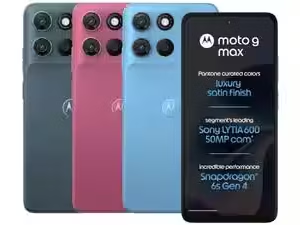
The Moto G Max has officially launched in India, bringing a massive 7,000mAh battery, a 50MP Sony LYTIA camera and Qualcomm’s Snapdragon 6s Gen 4 processor to Motorola’s mid-range lineup. The phone is priced at ₹27,999 for its 6GB RAM and 128GB storage configuration. Motorola is clearly focusing on endurance with the Moto G Max. Alongside its large battery, the phone gets a 6.72-inch Full HD+ display with a 120Hz refresh rate, 30W fast charging, stereo speakers and a ruggedness-focused design.
The smartphone is scheduled to go on sale in India from August 20.
Moto G Max Price and Availability in India
Motorola has launched the Moto G Max in a single 6GB + 128GB configuration, priced at ₹27,999. The phone will be available in three PANTONE-inspired colours: Alaskan Blue, Malaga and Stargazer. Motorola is also offering launch benefits, including selected bank-card discounts and exchange-related offers, although the exact promotional terms can vary.
Moto G Max Specifications at a Glance
| Feature | Moto G Max |
|---|---|
| Display | 6.72-inch Full HD+ LCD |
| Resolution | 1080 × 2400 |
| Refresh rate | 120Hz |
| Processor | Snapdragon 6s Gen 4 |
| RAM | 6GB LPDDR5X |
| Storage | 128GB UFS 3.1 |
| Rear camera | 50MP Sony LYTIA 600 + 8MP ultrawide |
| Front camera | 32MP |
| Battery | 7,000mAh |
| Charging | 30W |
| OS | Android 16 with Hello UI |
| Durability | MIL-STD-810H |
| Water resistance | IP64 |
| Display protection | Corning Gorilla Glass 7i |
| Audio | Stereo speakers with Dolby Atmos |
| Network | 5G |
The specification combination makes the battery the obvious headline feature, but the phone also gets relatively fast UFS 3.1 storage and LPDDR5X memory, which should help everyday responsiveness.
The 7,000mAh Battery Is the Big Story
The biggest selling point of the Moto G Max is undoubtedly its 7,000mAh battery. That’s considerably larger than the 5,000mAh batteries still common across many smartphones. Motorola pairs it with 30W fast charging, giving users a combination aimed at long periods away from a charger. For people who spend long days travelling, gaming, watching videos or using mobile data, the extra capacity could be more useful than chasing a thinner design. The trade-off is that the phone is positioned around endurance rather than flagship-level performance.
Snapdragon 6s Gen 4 Powers the Phone
The Moto G Max uses Qualcomm’s Snapdragon 6s Gen 4, paired with 6GB of LPDDR5X RAM. The processor is designed for mainstream smartphones, so the Moto G Max should be well suited to everyday activities such as social media, streaming, messaging, photography and moderate gaming. Motorola also includes RAM Boost, allowing part of the internal storage to be used as virtual memory. Some reports describe the system as providing up to 24GB of combined memory, but that should not be confused with 24GB of physical RAM. That’s an important distinction for buyers. The phone physically has 6GB of RAM in the Indian configuration.
120Hz LCD Display Instead of AMOLED
The phone features a 6.72-inch Full HD+ LCD display with a 120Hz refresh rate and up to around 1,050 nits of peak brightness according to launch coverage. It also uses Corning Gorilla Glass 7i for additional protection. The 120Hz refresh rate should make scrolling and animations feel smoother than a traditional 60Hz panel. However, the use of an LCD panel is one area where the Moto G Max faces stronger competition around the ₹28,000 price point. Several competing smartphones in this segment offer AMOLED displays, which generally provide deeper blacks and stronger contrast. That’s something buyers should consider before choosing the Moto G Max purely for its large battery.
More Read




50MP Sony LYTIA Camera Leads the Photography Setup
Motorola has equipped the Moto G Max with a 50MP Sony LYTIA 600 primary camera, accompanied by an 8MP ultra-wide camera. A 32MP front-facing camera handles selfies and video calls. The Sony LYTIA sensor is one of the more interesting pieces of the camera hardware, particularly for buyers who care about everyday photography. Motorola is also combining the camera system with its software and AI-powered photography tools. Still, the number of megapixels alone shouldn’t be treated as a guarantee of flagship-level image quality. Sensor size, processing, stabilization and lighting conditions all have a major impact on the final photograph.
Built to Handle Everyday Abuse
Motorola is giving the Moto G Max a stronger durability focus than many conventional mid-range phones. The device carries an IP64 rating and MIL-STD-810H durability certification. It also uses Gorilla Glass 7i on the display. The IP64 rating means protection against dust and resistance to water splashes. It does not mean the phone is waterproof or suitable for underwater use. The MIL-STD-810H designation also shouldn’t be interpreted as an unconditional guarantee that the phone cannot be damaged. Motorola’s durability testing is performed under specific laboratory conditions.
Android 16 and Hello UI
The Moto G Max ships with Android 16 and Motorola’s Hello UI software experience. Recent coverage indicates Motorola is promising two Android OS upgrades and three years of security updates for this model. That’s adequate for a mid-range smartphone, although buyers who keep phones for four or five years may find the update commitment less impressive than some competing devices. Motorola also includes its familiar software features and security tools alongside Google’s Android experience.
Is the Moto G Max Worth ₹27,999?
This is where the story gets interesting. The Moto G Max has an excellent battery proposition, a 120Hz screen, 5G connectivity, a Sony LYTIA camera and a durable build. But at ₹27,999, buyers aren’t simply comparing battery capacity anymore.
| What stands out | What could concern buyers |
|---|---|
| 7,000mAh battery | LCD rather than AMOLED |
| Snapdragon 6s Gen 4 | Only 6GB physical RAM |
| 50MP Sony LYTIA 600 | 128GB storage |
| 120Hz display | 30W charging |
| Gorilla Glass 7i | Two Android OS upgrades |
| MIL-STD-810H | Competitive ₹28K market |
| IP64 protection | No flagship-class chipset |
The phone therefore makes the most sense for someone who prioritizes battery life and durability over display technology and maximum performance.
Moto G Max vs the Competition
The ₹25,000–₹30,000 smartphone segment in India is particularly competitive. Buyers can find devices with AMOLED panels, faster processors, larger storage configurations and faster charging in this range. That means Motorola’s strategy is quite clear: the Moto G Max is not trying to win every specification battle. Instead, it is betting heavily on the combination of 7,000mAh battery + durability + Sony camera + Motorola software. That’s a sensible strategy, but whether it represents good value depends heavily on what you prioritize.
GizmoAlert’s Take
The Moto G Max is an interesting example of how smartphone manufacturers are responding to changing buyer priorities. Instead of chasing the thinnest body or the most powerful processor, Motorola has gone big on battery endurance and durability. The 7,000mAh battery is undoubtedly the phone’s biggest attraction. Add the 120Hz display, Sony LYTIA camera, 5G connectivity and MIL-STD-810H durability, and the package looks appealing for users who want a phone that can survive long days without constantly reaching for a charger. The bigger question is the ₹27,999 price. At this level, buyers have plenty of alternatives, including phones with AMOLED displays and more powerful processors. The Moto G Max therefore isn’t an obvious choice for performance enthusiasts.
But if your priority is simple — give me a phone with a huge battery, a good camera and enough power for everyday use — the Moto G Max makes a much stronger case. For battery-focused buyers, this could be one of Motorola’s more interesting launches of 2026.