



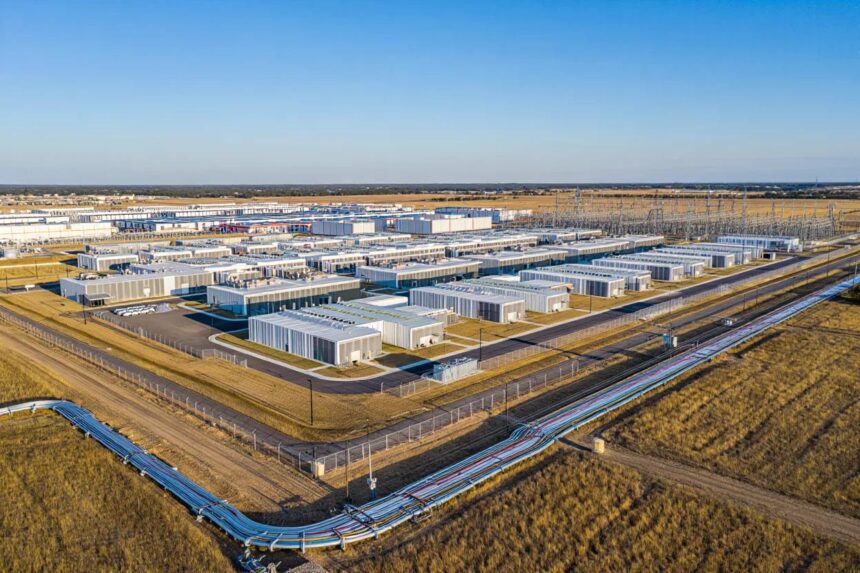
Artificial intelligence is changing the technology industry at an astonishing pace, but behind every AI model, chatbot and cloud service is something much less glamorous: electricity. Amazon’s latest Amazon AI Data Center project in West Texas has brought that problem into sharp focus after the company confirmed plans for a huge data-center campus in Pecos County that will initially be powered by dedicated, on-site generation rather than relying on the Texas electricity grid. The associated GW Ranch project has received approval for up to 7.65 gigawatts of gas-fired power generation, creating one of the clearest examples yet of how quickly AI’s appetite for electricity is reshaping America’s energy infrastructure. The headline number is enormous, but there is an important detail that often gets lost. 7.65GW is the permitted generation capacity, not a guarantee that the site will continuously produce 7.65GW or emit the maximum amount of pollution allowed by its permit. Pacifico Energy says GW Ranch is designed around more than 5GW of reliable power, with natural gas turbines complemented by battery storage and solar. The project is planned in phases, with first power targeted for 2027.
That distinction doesn’t make the environmental question disappear. It actually makes the story more interesting.
Why Amazon Needs So Much Power for AI
AI data centers are fundamentally different from many traditional computing facilities because training and running large AI models requires huge numbers of high-performance processors operating simultaneously. As companies deploy increasingly powerful AI systems, the amount of computing infrastructure required continues to rise.
Amazon is one of the world’s biggest cloud providers through AWS, and the company has been expanding its data-center capacity rapidly. Amazon’s latest sustainability report says it added more data-center capacity in 2025 than any other company globally. Its facilities achieved a global average Power Usage Effectiveness, or PUE, of 1.14, which Amazon says is 9% better than the public-cloud industry average.
That efficiency matters, but efficiency doesn’t automatically mean lower total electricity consumption. If demand for computing grows faster than efficiency improves, overall energy use can still increase. And that’s exactly the tension now emerging across the technology industry.
| What is increasing | Why it matters |
|---|---|
| AI model size | More computing power is required |
| AI inference | More users mean more ongoing computation |
| Data-center capacity | More servers require more electricity |
| GPU deployments | High-performance AI hardware has significant power requirements |
| Cooling infrastructure | More computing generates more heat |
| Network infrastructure | Larger AI workloads require more supporting equipment |
The 7.65GW GW Ranch Project Explained
The project at the center of the controversy is called GW Ranch, located in Pecos County, Texas, roughly 17 miles north of Fort Stockton. The Texas Commission on Environmental Quality approved an air permit covering up to 7.65GW of gas-fired generation at the site. Pacifico Energy describes GW Ranch as a private-grid energy campus designed specifically to supply hyperscale data centers and AI infrastructure. The project’s planned energy mix isn’t exclusively natural gas. Pacifico says the broader development includes battery storage and solar capacity, with more than 5GW of reliable generation planned as the project scales. Its current schedule calls for first power in the first quarter of 2027, with additional capacity coming online in phases.
| GW Ranch detail | Current information |
|---|---|
| Location | Pecos County, West Texas |
| Gas generation permit | Up to 7.65GW |
| Planned reliable generation | More than 5GW |
| Generation technology | Natural gas turbines |
| Solar component | 750MW planned |
| Battery storage | 1.8GW planned |
| First power target | Q1 2027 |
| Full buildout | Expected to extend into the early 2030s |
| Grid connection | Private/off-grid initially |
The project developer says the private-grid model allows the campus to move faster without waiting for a conventional grid connection. It also argues that the arrangement protects Texas electricity customers from having the data center’s demand directly raise pressure on the public grid.
More Read






The 33 Million Ton Emissions Figure Needs Context
This is where the story becomes particularly controversial.Recent reporting says the project’s air permit allows emissions of approximately 33 million tons of greenhouse gases per year at the permitted maximum. That figure has led to descriptions of the proposed plant as potentially becoming the largest single source of climate pollution from a power plant in the United States. But it is important not to present 33 million tons as Amazon’s expected annual emissions from the facility.
It is a permitted maximum, and actual emissions depend on how the plant operates. The Verge and other reporting have specifically noted that the plant would not necessarily emit its full permitted amount every year. That distinction is crucial for responsible technology reporting. Still, even the permitted ceiling illustrates the enormous scale of the infrastructure being contemplated to support AI.
Amazon’s Climate Pledge Makes the Story More Complicated
The project is particularly noteworthy because Amazon has made a major public commitment to reducing its environmental impact. Amazon co-founded The Climate Pledge in 2019 and committed to achieving net-zero carbon emissions across its operations by 2040. The company continues to describe that target as a core part of its sustainability strategy. Amazon’s latest sustainability report also highlights significant progress. The company says its data centers are seven times more water-efficient than the industry average, that its carbon intensity has fallen 38% since 2019, and that its carbon-free energy portfolio now spans more than 712 projects across 30 countries representing 42GW of capacity.
But there is another side to the numbers.
Amazon reported that its absolute carbon emissions increased in 2025, even though its carbon intensity improved. The company says its overall carbon intensity has fallen while revenue has grown substantially, but the increase in absolute emissions demonstrates the difficulty of expanding infrastructure while simultaneously reducing environmental impact. This is the central problem facing Amazon and other hyperscalers: AI infrastructure can become more efficient while total energy demand continues climbing.
Amazon Says the World Has Changed Since Its Climate Pledge
Amazon has not ignored the tension. In its sustainability material, the company acknowledges that its operations are expanding and says the path toward net-zero emissions will not necessarily be linear. Amazon’s latest sustainability report specifically points to growth in data centers and other infrastructure while maintaining its 2040 net-zero commitment. The company is also investing heavily in alternative energy sources. Amazon says its carbon-free energy portfolio includes renewable projects as well as investments in technologies such as next-generation nuclear power, geothermal energy and long-duration storage.
Amazon’s position is therefore more complicated than simply “Amazon chose gas over clean energy.” The company is simultaneously investing in clean energy while using natural gas to meet some immediate and highly concentrated power requirements. That is becoming a recurring pattern across the AI industry.
Why Texas Has Become an AI Power Hotspot
Texas is particularly attractive for massive data-center projects because it has abundant natural gas, large amounts of available land and a rapidly expanding technology infrastructure ecosystem.
The state is also experiencing an enormous wave of planned data-center construction. The Texas Tribune has reported that more than 80GW of new gas-fired power capacity is in the state’s construction pipeline, with roughly half intended to serve data centers, according to Global Energy Monitor data cited by the publication. The result is the emergence of what some analysts call a “shadow grid”—private power infrastructure built specifically around large data-center developments rather than relying entirely on conventional utility connections.
Amazon’s GW Ranch isn’t an isolated experiment. Chevron and Microsoft announced a separate West Texas project that will use dedicated natural-gas generation to supply a Microsoft-operated data center under a 20-year power agreement. That project is expected to provide approximately 2.67GW of capacity.
| Company/project | Planned power approach |
|---|---|
| Amazon / GW Ranch | Private generation with natural gas, solar and storage |
| Microsoft / Chevron Project Kilby | Dedicated natural-gas generation |
| Meta projects | Combination of grid and dedicated generation |
| Other hyperscalers | Growing interest in private power infrastructure |
The common thread is simple: AI companies need electricity faster than conventional grid infrastructure can always provide it.
Is Natural Gas Becoming the Shortcut for AI?
Natural gas has an obvious advantage for data-center operators: it can provide reliable power around the clock and can be deployed more quickly than some large-scale clean-energy projects. That reliability is particularly valuable for AI workloads. A data center cannot simply shut down whenever the wind stops blowing or the sun goes behind clouds. Batteries and other technologies can help smooth those fluctuations, but hyperscale AI facilities require extremely reliable electricity. This has pushed some companies toward gas-fired generation while longer-term clean-energy solutions are developed.
The risk, environmental groups and researchers argue, is that today’s temporary solution could become tomorrow’s permanent infrastructure. If billions of dollars are invested in gas turbines expected to operate for decades, companies could have less incentive—or less flexibility—to move entirely toward zero-carbon electricity.
The Water Question Is Important Too
Electricity isn’t the only environmental concern surrounding AI data centers. Large computing facilities also generate enormous amounts of heat, meaning cooling systems require resources of their own. West Texas is already a water-sensitive region, making this an important part of the GW Ranch discussion.
Pacifico Energy says GW Ranch was specifically designed with water constraints in mind and says its generation system is intended to be self-sufficient. The company also describes potential future use of waste heat for desalination. Amazon’s own sustainability report says its data centers are significantly more water-efficient than industry averages and that the company is expanding reclaimed-water use and other conservation measures.
So again, the picture isn’t simply black and white. The technology industry is improving the efficiency of individual data centers while simultaneously building far more of them.
The Bigger Question: Who Pays for the AI Boom?
This may ultimately be the most important question. If AI companies connect enormous facilities directly to public grids, electricity demand can put pressure on utilities and potentially affect infrastructure costs for other customers.
Private power generation changes that equation. Amazon says its Pecos County campus will initially use new on-site generation and argues that this avoids increasing electricity costs for Texas households. The company also says it intends to transition toward grid-connected service as interconnection timelines allow. That may protect ordinary electricity customers from some immediate costs, but it doesn’t eliminate the broader environmental costs of producing the electricity. Someone still has to supply the natural gas. Someone has to build the turbines. The resulting emissions still enter the atmosphere.
That’s why the debate around AI power is becoming much bigger than a single Amazon project.
The AI Energy Problem Is Bigger Than Amazon
Amazon is receiving the most attention because the GW Ranch project is unusually large, but the underlying issue affects nearly every major AI company. A 2026 research study examining U.S. hyperscale data centers estimated that facilities operating between May 2024 and April 2025 consumed roughly 68–99 terawatt-hours of electricity, with fossil fuels supplying about 54% of the associated generation in the study’s central analysis. Another study projects that electricity consumption from major AI infrastructure could continue rising sharply through 2030, particularly in regions where data-center development is concentrated.
That means the real story isn’t simply:
“Amazon is polluting.”
It’s:
AI is creating an electricity demand problem that the technology industry has not yet completely solved.
GizmoAlert Insight
The Amazon AI Data Center story is fascinating because it exposes a contradiction at the heart of the current AI boom. Technology companies are making their chips more efficient, their cooling systems smarter and their data centers less wasteful. At the same time, they are building these facilities at a scale that can overwhelm those efficiency gains. Amazon’s own numbers illustrate the problem. Its data centers are becoming more efficient, its renewable-energy portfolio is enormous, and its carbon intensity has improved. Yet absolute emissions still rose in 2025.
That doesn’t necessarily mean Amazon’s climate strategy has failed. It means efficiency and sustainability aren’t the same thing when demand is growing this quickly.
And that’s a problem the entire AI industry will have to confront.
What Happens Next?
The GW Ranch project is expected to begin delivering power in 2027, with capacity expanding in phases. Pacifico Energy says the site could eventually provide more than 5GW of reliable power while incorporating solar and battery storage. The important thing to watch won’t simply be whether the project becomes operational. It will be how much electricity the Amazon AI Data Center actually consumes, how often the gas turbines operate, what portion of its energy ultimately comes from lower-carbon sources, and whether Amazon can reconcile that growth with its 2040 net-zero commitment.
The answers will provide an important real-world test for whether the AI industry’s extraordinary growth can coexist with increasingly ambitious climate targets.
Final Thoughts
Amazon’s Texas AI data-center project is a glimpse into a future that is arriving faster than many people expected. AI may feel like software, but the infrastructure behind it is very physical: giant buildings, thousands of servers, cooling systems, power lines, batteries, solar farms and, increasingly, natural-gas turbines. The 7.65GW GW Ranch permit doesn’t mean Amazon will immediately consume or emit at that maximum level. But it demonstrates the enormous scale of the electricity infrastructure being considered for AI.
Amazon says it remains committed to net-zero carbon emissions by 2040 and is investing heavily in renewable and carbon-free energy. Critics, meanwhile, see the Texas project as evidence that the AI boom could lock the industry into fossil-fuel infrastructure for years.
Both sides of that debate deserve attention. Because the real question isn’t whether AI will consume more electricity.
It already is.
The question is whether the technology industry can build enough clean, reliable power quickly enough to keep up.