


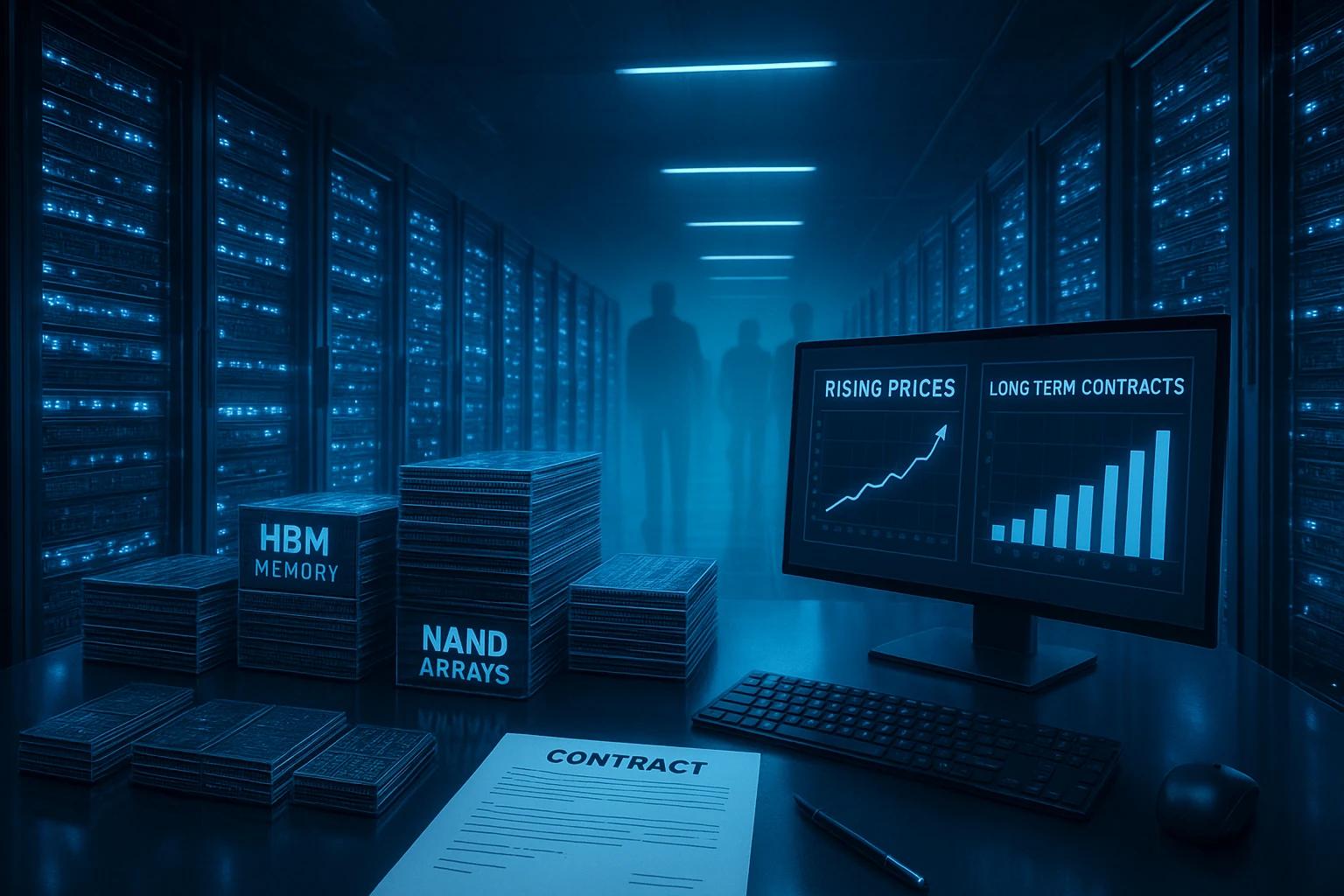


For most people, artificial intelligence still feels like a software revolution. Consumers see smarter chatbots, more advanced voice assistants, image generation tools improving every month, and technology companies announcing increasingly ambitious AI products. What remains largely invisible, however, is the enormous physical infrastructure required to support this global transformation, and that hidden demand is now quietly triggering a serious RAM shortage that could soon affect the price of everyday consumer technology.
Behind every AI breakthrough sits a massive network of data centers filled with specialized hardware, powerful GPUs, advanced cooling systems, and enormous amounts of memory. As technology companies continue expanding this infrastructure at record speed, semiconductor manufacturers are being forced to shift production priorities toward AI hardware, creating supply pressure that is beginning to ripple across the entire electronics industry.
For consumers, the consequences may arrive sooner than expected.
Why AI Is Suddenly Creating A Global RAM Shortage
The recent explosion in artificial intelligence development has fundamentally changed how the semiconductor market operates. Unlike traditional enterprise servers that manage standard cloud computing tasks, modern AI servers are built to process extremely large models that require far more memory capacity to function efficiently. Industry analysts now estimate that a single AI server can consume nearly ten to twenty times more memory than a conventional server performing standard workloads.
That sudden spike in infrastructure demand is becoming one of the biggest reasons behind the growing RAM shortage now developing across the global semiconductor supply chain. Companies building AI platforms are purchasing memory at an unprecedented scale, forcing suppliers to redirect production capacity toward enterprise customers that are willing to pay premium pricing for guaranteed supply.
The problem is simple. Manufacturing capacity cannot expand overnight.
Chip Manufacturers Are Following The Money
Some of the world’s biggest semiconductor companies, including Samsung Electronics, SK Hynix, and Micron Technology, are now aggressively increasing production of high-bandwidth memory, commonly known as HBM, which has become critical for training and running large-scale artificial intelligence systems.
More Read




From a business perspective, this shift makes perfect sense. Cloud providers and hyperscale infrastructure companies are signing long-term contracts worth billions, often securing premium supply agreements years in advance. Traditional consumer electronics manufacturers simply cannot compete at the same level, which means semiconductor companies are naturally allocating more production capacity toward the part of the market generating stronger returns.
According to recent industry trends tracked by Micron Technology and other semiconductor manufacturers, demand for advanced AI memory solutions continues accelerating faster than previously expected, putting even more pressure on already constrained supply chains.
Why Consumers Could Soon Start Paying More
This growing RAM shortage is no longer an isolated manufacturing issue affecting only enterprise technology companies. The same semiconductor ecosystem responsible for powering artificial intelligence infrastructure also supplies memory components used in smartphones, gaming consoles, tablets, premium laptops, and connected smart home devices.
Recent market data suggests DRAM contract prices have already surged sharply over the past year, signaling the early stages of supply imbalance. If manufacturers continue prioritizing AI hardware production, consumers may soon begin noticing more expensive flagship smartphones, rising laptop prices, and premium gaming hardware launching at significantly higher price points.
In simple terms, the cost of building the future of artificial intelligence may quietly begin landing on consumers.
The Numbers Behind The Growing Supply Shift
Only a few years ago, global data centers consumed roughly twenty to thirty percent of total semiconductor memory production. That balance has now shifted dramatically as artificial intelligence infrastructure continues expanding across every major technology company worldwide.
Analysts now believe that by the end of 2026, data centers alone could consume nearly seventy percent of all memory chips produced globally. That is a dramatic change in an industry where manufacturing expansion often moves much slower than sudden spikes in demand, making the current RAM shortage far more difficult to solve quickly.
Global Memory Demand Forecast
| Year | Estimated Data Center Memory Consumption |
|---|---|
| 2022 | 20% – 30% |
| 2025 | Sharp AI-driven growth |
| 2026 | Nearly 70% of global supply |
Research groups including IDC Research have repeatedly warned that hyperscale AI infrastructure could permanently reshape how semiconductor supply gets distributed over the coming years.
Why The Industry Cannot Fix This Overnight
Unlike software problems that can often be solved quickly, semiconductor manufacturing depends on highly specialized fabrication facilities that require billions of dollars in investment and years of construction before new capacity becomes operational. Even though chip manufacturers are already expanding aggressively, experts believe the current RAM shortage may continue affecting global supply for at least another one to two years.
What makes the situation even more challenging is that demand itself is still accelerating faster than new factories can be built. By the time additional manufacturing capacity becomes available, artificial intelligence infrastructure demand may have already grown significantly beyond current projections.
This creates an uncomfortable cycle where supply continuously struggles to catch up.
Smarter AI May Be The Real Long-Term Solution
Interestingly, some experts believe the technology industry is focusing too heavily on hardware expansion while ignoring software efficiency. Instead of continuously building larger data centers, future AI systems may need to rely on smaller specialized models, improved data compression techniques, edge computing strategies, and more efficient algorithms capable of delivering similar performance without consuming enormous hardware resources.
The current RAM shortage may ultimately force companies to rethink how artificial intelligence infrastructure is being designed in the first place.
Simply building more data centers forever is not a sustainable long-term strategy.
Consumers Are Now Indirectly Funding The AI Race
Most people rarely think about data centers because they feel disconnected from everyday life. In reality, the smartphone sitting in your pocket, the gaming console connected to your television, and the laptop you rely on for work all depend on the same semiconductor supply chain now being aggressively redirected toward artificial intelligence development.
The global RAM shortage developing today may become one of the earliest warning signs that the AI revolution is beginning to reshape far more than software alone. Behind every breakthrough model sits an enormous infrastructure bill, and increasingly, that cost may begin affecting consumers worldwide in ways most people have not yet fully realized.
Artificial intelligence is transforming the future faster than expected, but building that future requires physical infrastructure on a scale the world has never experienced before.
And somebody eventually pays for that expansion.
The biggest cost of the AI revolution may not be software itself, but the hidden hardware crisis quietly building underneath it.
What Do You Think?
If artificial intelligence continues consuming global chip supply at this pace, should semiconductor companies prioritize consumer technology production, or should AI infrastructure remain the top priority for future innovation?
Share your thoughts with us below..