




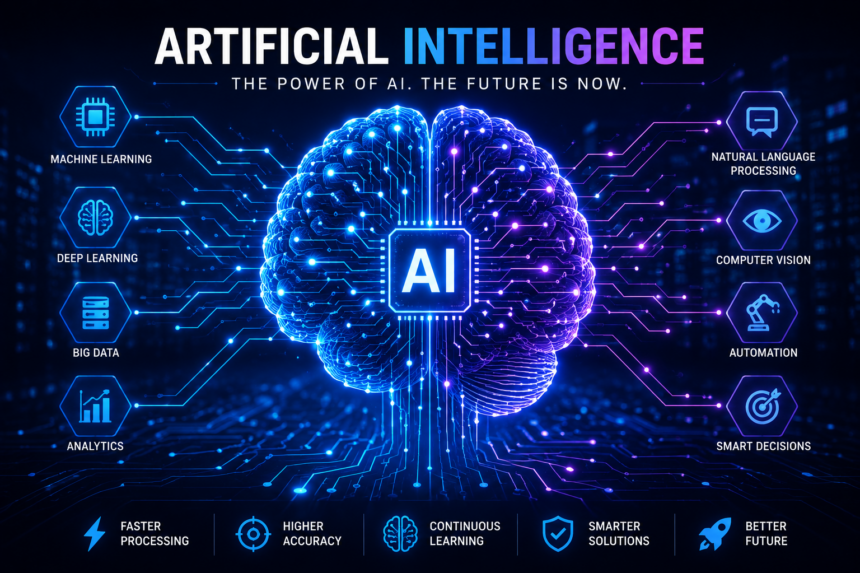
Artificial Intelligence has rapidly evolved from a futuristic concept into a technology that millions of people use every day. Whether you’re asking a virtual assistant for directions, using AI-powered photo editing, or interacting with chatbots, AI is already a part of your daily routine.
In recent years, advances in machine learning, cloud computing, and large language models have accelerated AI development at an unprecedented pace. Businesses, governments, educators, healthcare providers, and software developers are investing heavily in AI solutions to improve productivity, automate repetitive tasks, and create more personalized digital experiences.
This guide explains how Artificial Intelligence works, where it’s being used today, its biggest advantages and challenges, and why it is expected to become even more influential over the coming decade.
What Is Artificial Intelligence?
Artificial Intelligence, commonly known as AI, refers to computer systems that can perform tasks normally requiring human intelligence. These tasks include learning from data, recognizing speech and images, understanding language, solving problems, making decisions, and generating content.
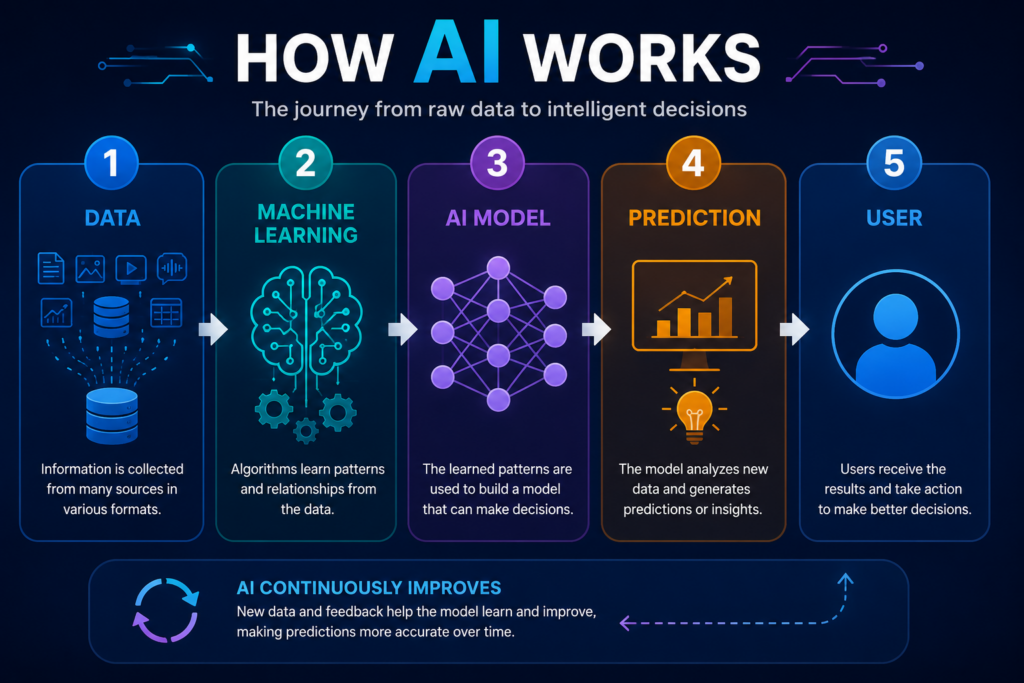
Unlike traditional software that follows fixed instructions, AI systems improve their performance by analyzing large amounts of information and identifying patterns. This allows them to make predictions, answer questions, and adapt to new situations without being explicitly programmed for every scenario.
Today’s AI powers search engines, recommendation systems, voice assistants, autonomous vehicles, fraud detection, and countless other technologies.
How Does AI Work?
Artificial Intelligence combines several technologies that work together to process information and make intelligent decisions.
More Read




Machine learning enables computers to learn from historical data instead of relying entirely on manually written rules. Deep learning, a specialized branch of machine learning, uses artificial neural networks that mimic how the human brain processes information. Natural Language Processing allows AI systems to understand and generate human language, making conversations with chatbots and virtual assistants possible.
Computer vision gives machines the ability to recognize objects, faces, documents, and scenes from images or video. Together, these technologies allow AI systems to continuously improve as they process more information.
Types of Artificial Intelligence
Artificial Intelligence is generally divided into several categories based on its capabilities.
Narrow AI
Most AI systems available today fall into this category. They are designed to perform specific tasks such as translating languages, recommending movies, recognizing faces, or answering customer support questions.
Examples include ChatGPT, Google Gemini, Siri, Alexa, and AI-powered image generators.
General AI
General Artificial Intelligence remains a long-term research goal. Unlike today’s AI, General AI would be capable of understanding and performing almost any intellectual task that a human can complete.
No true General AI currently exists.
Superintelligence
This theoretical stage describes AI systems that could surpass human intelligence across virtually every field. While often discussed in research and science fiction, it remains speculative.
Where Is AI Used Today?
Artificial Intelligence has become one of the most widely adopted technologies across industries.
Healthcare organizations use AI to assist doctors with disease detection, medical imaging, and drug discovery. Financial institutions rely on AI to detect fraud, evaluate credit risk, and automate customer support.
In the technology sector, AI powers smart assistants, translation tools, personalized recommendations, spam filtering, and software development. Retail companies analyze customer behavior to recommend products and optimize inventory.
Manufacturing companies use AI for predictive maintenance, quality control, and industrial automation. Meanwhile, cybersecurity teams depend on AI to identify threats faster and strengthen digital defenses.
Even smartphones now use AI for photography, voice recognition, battery optimization, live translation, and productivity features.
Benefits of Artificial Intelligence
AI offers significant advantages for individuals and businesses alike.
It automates repetitive work, allowing employees to focus on higher-value tasks. Businesses can process massive amounts of data much faster than humans, helping them make better decisions based on real-time insights.
Artificial Intelligence also improves customer service through intelligent chatbots that operate around the clock. In healthcare, AI assists doctors by identifying diseases earlier and supporting treatment planning.
Consumers benefit from more personalized experiences, smarter search results, accurate navigation, language translation, and intelligent recommendations across streaming services and online shopping platforms.
Challenges and Risks of AI
Despite its advantages, Artificial Intelligence also presents important challenges.
AI systems depend heavily on the quality of the data used during training. Poor or biased data can produce unfair or inaccurate results.
Privacy remains another major concern, as many AI applications process sensitive personal information. Organizations must ensure that AI systems comply with data protection regulations and ethical standards.
The growing use of AI has also raised questions about job displacement. While AI creates new opportunities, it can automate certain routine tasks previously performed by humans.
Cybersecurity is another emerging challenge. As AI becomes more powerful, attackers are increasingly using it to create sophisticated phishing campaigns, deepfakes, and automated malware. At the same time, security professionals are using AI to strengthen threat detection and incident response.
GizmoAlert Insight: Artificial Intelligence is not replacing human expertise—it is becoming a powerful tool that enhances productivity, improves decision-making, and automates repetitive tasks. The organizations that combine human knowledge with responsible AI adoption are likely to see the greatest long-term success.
The Future of Artificial Intelligence
AI development continues to accelerate across nearly every industry.
Future innovations are expected to improve robotics, autonomous transportation, personalized healthcare, scientific research, education, and business automation. Smaller, faster AI models are also making it possible to run advanced AI features directly on smartphones, laptops, and edge devices without relying entirely on cloud computing.
Governments and technology companies are simultaneously working on regulations that promote responsible AI development while encouraging innovation.
As AI becomes more accessible, understanding how it works will become an increasingly valuable skill for students, professionals, and businesses alike.
Final Thoughts
Artificial Intelligence is no longer a technology reserved for research laboratories or large technology companies. It has become an essential part of modern digital life, powering everything from smartphones and online shopping to healthcare, finance, and cybersecurity.
While challenges such as privacy, bias, and responsible use remain important, AI continues to create opportunities for innovation across virtually every industry. As technology advances, understanding Artificial Intelligence will help individuals make informed decisions, develop valuable skills, and adapt to a rapidly evolving digital world.
For anyone interested in the future of technology, AI is no longer optional knowledge—it is becoming a fundamental part of everyday life.