



What Is Artificial Intelligence?
Artificial Intelligence (AI) is one of the fastest-growing technologies in the world today. From recommending movies on streaming platforms to helping doctors diagnose diseases, AI has become part of everyday life, often without people realizing it.
Simply put, artificial intelligence refers to computer systems designed to perform tasks that normally require human intelligence. These tasks include learning, problem-solving, understanding language, recognizing images, making decisions, and even creating new content.
Unlike traditional software that follows fixed instructions, AI systems learn from data, recognize patterns, and improve their performance over time.
Why Is Artificial Intelligence Important?
AI is changing nearly every industry. Businesses use it to automate repetitive tasks, improve customer experiences, analyze massive amounts of data, and make faster decisions.
Consumers interact with AI every day through voice assistants, online shopping recommendations, facial recognition, spam filters, language translation, and navigation apps.
Experts believe artificial intelligence will become as important as electricity and the internet over the coming decades because it has the potential to reshape almost every aspect of modern life.
How Does Artificial Intelligence Work?
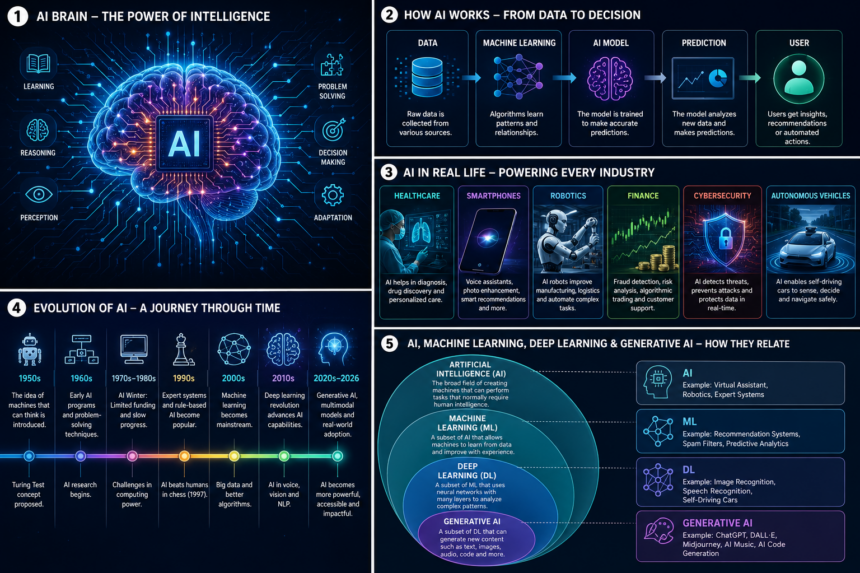
At its core, AI follows a simple process. First, it collects large amounts of data. That data is then processed using algorithms designed to identify relationships and patterns. Machine learning models analyze the information repeatedly until they become capable of making accurate predictions or decisions.
More Read




Once trained, the AI model can apply what it has learned to new situations without needing explicit programming for every possible scenario. For example, an AI image recognition system learns by analyzing millions of pictures. Over time, it becomes capable of identifying objects, people, animals, or vehicles in images it has never seen before.
The Building Blocks of AI
Artificial intelligence relies on several core technologies that work together.
Machine Learning
Machine learning allows computers to learn from data instead of relying entirely on manually written rules. The more quality data a system receives, the better it usually becomes.
Deep Learning
Deep learning is an advanced form of machine learning that uses artificial neural networks inspired by the human brain. It excels at image recognition, speech processing, language understanding, and autonomous driving.
Natural Language Processing (NLP)
Natural Language Processing enables computers to understand, interpret, and generate human language. Chatbots, virtual assistants, translators, and AI writing tools all depend heavily on NLP.
Computer Vision
Computer vision allows machines to analyze photos and videos. It powers facial recognition, medical imaging, security cameras, autonomous vehicles, and manufacturing inspection systems.
Generative AI
Generative AI creates new content rather than simply analyzing existing information. It can generate text, images, videos, music, software code, and even scientific research.
GizmoAlert Insight: Artificial intelligence doesn’t “think” like humans. Instead, it identifies patterns in enormous datasets and uses probability to generate the most likely response or prediction.
Types of Artificial Intelligence
AI is generally divided into three categories.
Narrow AI
Also called Weak AI, Narrow AI is designed for one specific task.
Examples include:
- Voice assistants
- Recommendation systems
- Spam detection
- Image recognition
- Chatbots
Almost every AI system available today falls into this category.
General AI
General AI refers to a machine capable of performing any intellectual task that a human can perform. Although researchers continue working toward this goal, true General AI does not yet exist.
Superintelligence
Artificial Superintelligence is a hypothetical future form of AI that surpasses human intelligence across every field. It remains a theoretical concept rather than a real technology.
Real-World Applications of Artificial Intelligence
AI has become deeply integrated into everyday life.
Healthcare
Doctors use AI to analyze medical images, predict diseases, assist in drug discovery, and improve patient care.
Finance
Banks rely on AI to detect fraud, assess credit risk, automate customer service, and analyze investment opportunities.
Retail
Online stores recommend products based on browsing history, purchasing habits, and customer preferences.
Transportation
Self-driving vehicles use AI to understand road conditions, identify pedestrians, and navigate safely.
Manufacturing
Factories use AI-powered robots to improve production efficiency and detect equipment failures before they occur.
Cybersecurity
Security platforms use AI to identify suspicious behavior, detect malware, and respond to cyber threats more quickly.
Education
Learning platforms personalize lessons based on student progress and automatically generate quizzes and feedback.
Artificial Intelligence in Everyday Life
Many people use AI dozens of times each day without noticing.
Examples include:
- Google Search
- ChatGPT
- Siri
- Google Assistant
- Alexa
- Netflix recommendations
- Spotify playlists
- Gmail spam filtering
- Google Maps navigation
- Smartphone cameras
- Face Unlock
- Online shopping recommendations
AI has quietly become one of the most widely used technologies in the modern world.
Benefits of Artificial Intelligence
Artificial intelligence offers several important advantages.
It can automate repetitive work, improve accuracy, reduce human error, process enormous datasets within seconds, operate continuously, and support better decision-making.
Businesses benefit from increased productivity, while consumers enjoy more personalized digital experiences.
Challenges and Risks
Despite its benefits, AI also raises important concerns. Privacy remains one of the biggest issues because many AI systems require large amounts of personal data. Bias is another challenge. AI models can produce unfair outcomes if trained on biased datasets. Automation may also change the job market by replacing certain repetitive roles while creating entirely new career opportunities. Misinformation generated by AI, deepfake videos, copyright disputes, and cybersecurity threats continue to receive growing attention from governments and technology companies.
The Future of Artificial Intelligence
AI is expected to become even more capable over the next decade. Experts predict improvements in robotics, healthcare, education, transportation, scientific research, software development, and climate modeling. Rather than replacing humans entirely, AI will likely become a powerful tool that helps people solve increasingly complex problems more efficiently. Governments and technology companies are also developing regulations to encourage responsible AI development while minimizing potential risks.
Frequently Asked Questions
Is AI the same as Machine Learning?
No. Machine Learning is a branch of Artificial Intelligence that enables systems to learn from data.
Can AI think like humans?
Not today. Current AI recognizes patterns and predicts outcomes, but it does not possess consciousness or emotions.
Is AI dangerous?
AI itself is a tool. Its impact depends on how people design, regulate, and use it.
Will AI replace jobs?
AI will automate some tasks while creating new roles in technology, engineering, healthcare, cybersecurity, and many other industries.
Can AI make mistakes?
Yes. AI models can produce incorrect or biased results, especially when trained on poor-quality data.
Final Thoughts
Artificial Intelligence has moved beyond science fiction and become an essential part of everyday life. From healthcare and finance to gaming and smartphones, AI is transforming how people work, communicate, and solve problems.
Understanding the basics of artificial intelligence is becoming increasingly important as businesses, governments, and consumers rely on AI-powered technologies more than ever before.
While challenges remain, AI is expected to continue driving innovation across nearly every industry. Learning how it works today will help individuals and organizations prepare for the opportunities and responsibilities that lie ahead.