




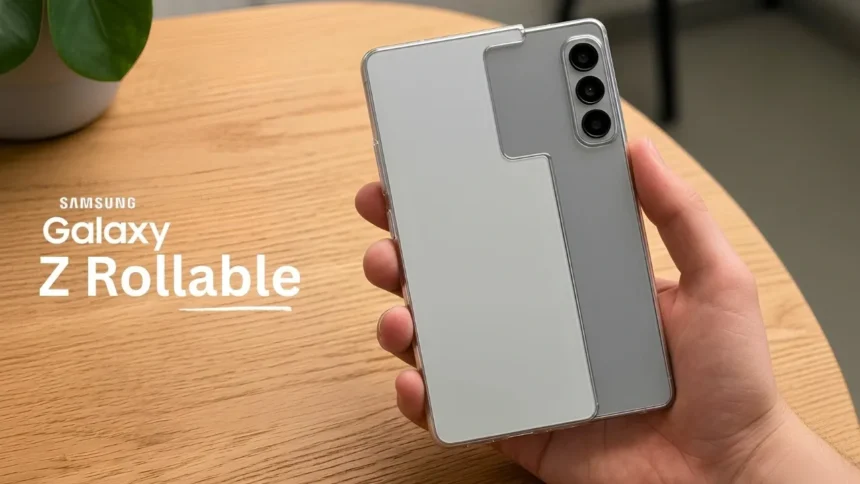
Samsung appears to be quietly expanding its long-term smartphone research beyond the foldable hardware category that has largely defined recent years of mobile innovation. New developments surrounding the company’s experimental rollable smartphone technology suggest that major manufacturers may already be preparing for the next major transition in how mobile devices are physically designed, potentially introducing a future where smartphone displays can dynamically expand and contract depending on user needs.
For much of the past decade, smartphone design innovation has largely followed predictable patterns. Manufacturers competed through camera improvements, battery optimization, processor performance, and minor display refinements while maintaining nearly identical physical hardware design language. Foldable devices temporarily disrupted that pattern by introducing entirely new interaction models, but the broader industry now appears focused on pushing hardware experimentation significantly further.
Samsung’s latest concept development suggests foldables may only represent an intermediate step rather than the final destination of smartphone evolution.
The Search For New Smartphone Form Factors Is Accelerating
One major challenge currently facing the global smartphone industry involves innovation fatigue surrounding traditional hardware design. Modern smartphones have reached a level of maturity where annual hardware upgrades increasingly feel incremental rather than revolutionary, forcing manufacturers to search aggressively for entirely new product categories capable of redefining consumer interest.
Foldable smartphones represented one early attempt to solve this challenge by transforming how devices physically interact with users. However, rollable display technology introduces an even more ambitious concept. Unlike foldable hardware that physically bends along hinge mechanisms, rollable devices allow display surfaces to expand dynamically while maintaining more compact physical dimensions during normal use.
This fundamentally changes the relationship between screen size and portability. Manufacturers are increasingly experimenting with hardware capable of adapting physically in real time.
Flexible Display Engineering Is Becoming A Strategic Battleground
Samsung’s continued investment in advanced display technology reflects a much larger competitive battle unfolding across the broader consumer electronics industry. Display engineering increasingly represents one of the most important strategic advantages companies can control as smartphones approach technological maturity across traditional hardware categories.
More Read






The ability to manufacture stronger flexible display materials, improve long-term durability, reduce mechanical failure points, and create seamless software adaptation across changing screen dimensions will likely define the next major generation of premium mobile hardware. This competition extends far beyond visual aesthetics.
Future smartphone design increasingly depends on whether devices themselves can physically transform around different usage environments.Hardware flexibility is gradually becoming a new category of innovation.
Foldable Devices May Only Represent The Beginning
One interesting implication emerging from Samsung’s continued hardware experimentation involves the possibility that today’s foldable devices may eventually serve as transitional technology rather than long-term end products. The broader industry increasingly recognizes that future mobile computing may require entirely new interaction models capable of balancing portability with larger workspace experiences previously limited to tablets or laptops.
Rollable hardware potentially solves part of that challenge by allowing significantly larger display areas without permanently increasing physical device size. If engineering challenges surrounding durability and cost eventually improve, rollable smartphones may gradually enter premium consumer markets over the coming years. This would mark another major turning point for mobile technology evolution.
The Smartphone Industry Is Quietly Preparing For Its Next Reinvention
Samsung’s latest experimental hardware direction demonstrates a larger reality now affecting the entire mobile technology industry. Smartphones have reached a stage where traditional upgrades alone no longer generate the same consumer excitement seen during earlier technology cycles.
Manufacturers now face growing pressure to rethink what smartphones physically become over the next decade.
Artificial intelligence integration, adaptive hardware design, flexible displays, contextual computing systems, and increasingly personalized digital experiences are all beginning to reshape the future of consumer technology.
Samsung appears determined to remain one of the companies leading that transformation.
And the smartphone industry may already be preparing for a design revolution consumers have not fully seen yet.