


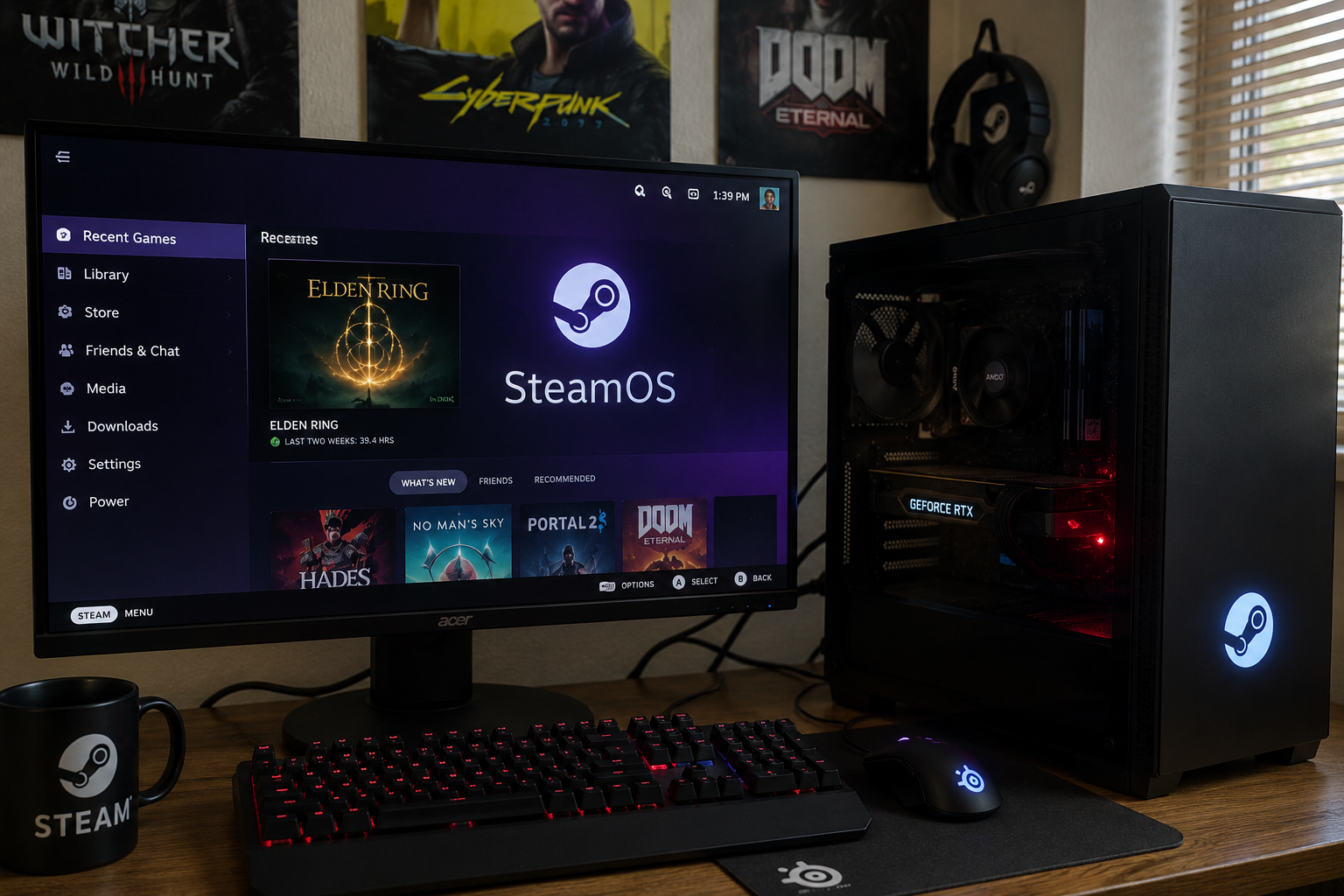


For decades, Windows has been the default operating system for PC gaming. Nearly every major game, launcher, graphics driver, and gaming peripheral has been built with Microsoft’s platform in mind. That dominance has remained largely uncontested, despite repeated attempts by Linux-based alternatives to attract gamers.
Valve now appears ready to challenge that status quo once again. The company behind Steam is expanding SteamOS beyond the Steam Deck, bringing broader support for desktop PCs and additional hardware configurations. While Valve isn’t asking gamers to abandon Windows overnight, the move signals a much larger ambition: making SteamOS a practical gaming platform for millions of PC users.
SteamOS Is Growing Beyond the Steam Deck
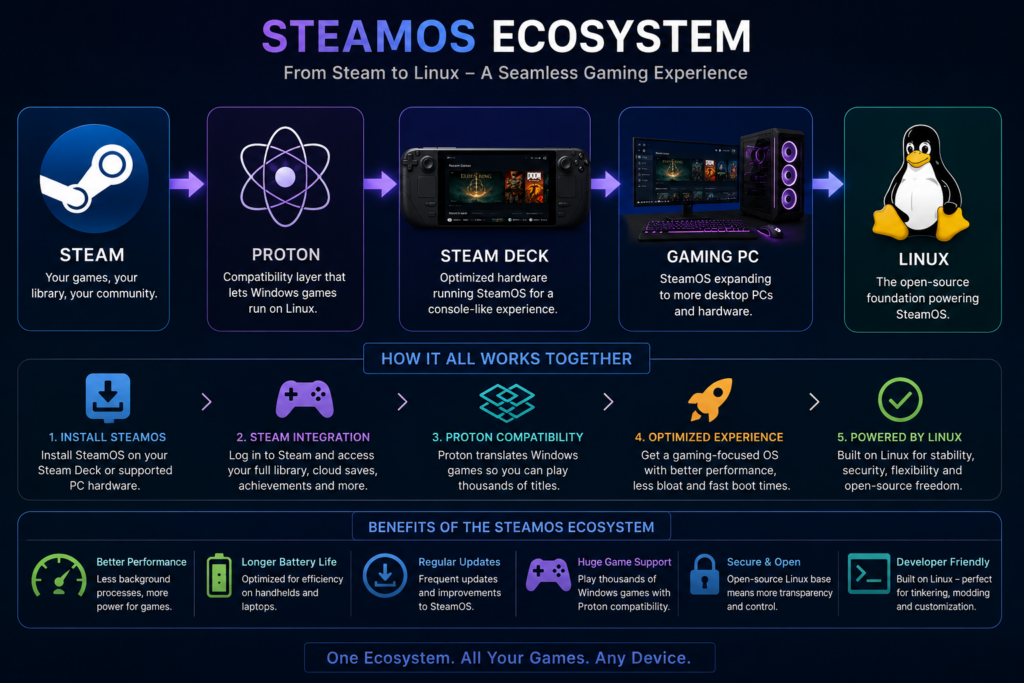
When SteamOS first launched, it was closely tied to Valve’s handheld Steam Deck. The Linux-based operating system combined a console-like interface with the flexibility of PC gaming, allowing players to access thousands of Steam titles without running Windows. Since then, Valve has steadily improved compatibility through Proton, its compatibility layer that enables many Windows games to run on Linux with little or no user intervention.
Now, Valve is extending SteamOS support to a wider range of desktop hardware. The goal is to make installation easier for enthusiasts while improving compatibility across AMD, Intel, and NVIDIA systems. Although SteamOS isn’t officially available for every gaming PC today, recent development efforts clearly indicate that Valve is preparing for broader adoption.
More Read






Why Valve Wants to Break Windows’ Hold on PC Gaming
Microsoft still dominates desktop gaming, but Windows has become increasingly complex over the years. Features unrelated to gaming, background services, advertising, telemetry, and AI integrations have led some players to seek leaner alternatives. Valve sees an opportunity. By controlling both Steam and the operating system, the company can deliver a gaming-first experience without many of the distractions associated with traditional desktop operating systems.
Players could potentially benefit from:
| SteamOS Advantage | What It Means |
|---|---|
| Faster boot times | Less waiting before gaming |
| Gaming-focused interface | Console-like simplicity |
| Lower system overhead | More resources available for games |
| Regular Steam integration | Seamless updates and library management |
| Open-source Linux base | Greater flexibility for advanced users |
Rather than replacing Windows entirely, Valve appears focused on creating an operating system designed specifically around gaming.
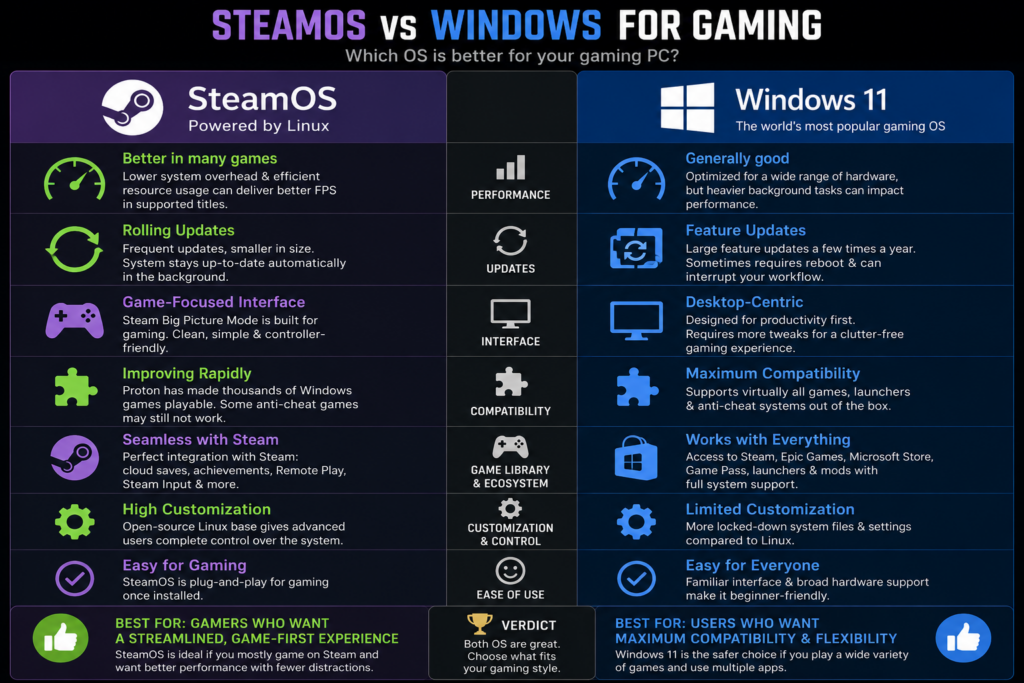
GizmoAlert Insight: SteamOS isn’t trying to become another general-purpose operating system. Its goal is to become the easiest and most efficient way to play PC games.
Proton Has Changed Everything
One of the biggest reasons SteamOS is now being taken seriously is Proton. Several years ago, Linux gaming required extensive technical knowledge, and many popular games simply didn’t work. Proton has changed that dramatically by allowing thousands of Windows games to run with minimal setup. Many titles now perform similarly to their Windows counterparts, while some even show small performance improvements depending on the hardware and game engine.
Although certain multiplayer games using kernel-level anti-cheat still present compatibility challenges, the list of supported games continues to grow.
Hardware Support Is Improving
Valve has also been working closely with hardware vendors to improve driver support. AMD hardware generally offers the best SteamOS experience today thanks to mature open-source Linux drivers. Intel graphics compatibility continues to improve with every major driver release, while NVIDIA has made significant progress by modernizing its Linux driver stack and working more closely with the Linux gaming ecosystem. As driver support improves, installing SteamOS on desktop gaming PCs becomes increasingly realistic for mainstream users.
Could SteamOS Bring Back the Steam Machine Vision?
Valve’s original Steam Machines launched in 2015 with ambitious goals but failed to gain widespread adoption. Limited game compatibility, inconsistent hardware, and early Linux gaming challenges prevented the project from competing with Windows. The situation looks very different in 2026. Steam Deck has already demonstrated that gamers are willing to embrace Linux if the experience is polished and games simply work. Proton has matured significantly, and hardware support is stronger than ever. Some analysts believe SteamOS is quietly becoming the modern version of the Steam Machine concept—this time backed by years of software improvements and a much larger ecosystem.
What About Windows?
Windows isn’t going anywhere. It remains the most widely supported gaming platform, offering unmatched compatibility for software, peripherals, professional applications, and anti-cheat systems. However, SteamOS introduces meaningful competition for the first time in years. Gamers who primarily use their PCs for Steam titles may eventually find that a dedicated gaming operating system offers a simpler and more streamlined experience. Competition could also encourage Microsoft to continue improving Windows for gamers, leading to better experiences regardless of which platform users choose.
The Bigger Picture
SteamOS represents more than another Linux distribution. It reflects Valve’s long-term strategy to reduce dependence on Microsoft’s ecosystem while giving players greater flexibility over how they access their game libraries. Combined with the success of the Steam Deck, expanding hardware compatibility, and ongoing improvements to Proton, SteamOS is becoming one of the most significant developments in PC gaming infrastructure. Whether it ultimately replaces Windows for a large number of gamers remains uncertain. What is clear is that Valve is building an ecosystem that extends far beyond a handheld gaming device.
The Bottom Line
Valve’s expansion of SteamOS marks an important step toward a more competitive future for PC gaming. By extending support beyond the Steam Deck and improving compatibility across desktop hardware, the company is laying the groundwork for an operating system built entirely around gamers’ needs. Windows is likely to remain the dominant platform for years to come, but SteamOS no longer feels like an experiment. Instead, it has evolved into a serious alternative that could reshape how gamers think about operating systems in the years ahead. As Valve continues refining the platform, one question becomes increasingly relevant: if SteamOS can deliver the same games with a smoother gaming-focused experience, will more players eventually decide they no longer need Windows?